The ramshackle Little miss sunshine’s family was keeping company with us, through our laptop’s monitor, on the Alitalia airplane that was entering the Persian territory, in the middle of the night, as the immense Tehran commenced to grant us glimpse some faint lights beyond the window.
Goodness knows for how many years I have been imagining that moment – the moment when Godot would finally come.
A woman, as soon as the plane had landed and the light signal had communicated to unfasten the seat belts, arranged a scarf on her own head.
The nightmare of a long queue at the immigration checkpoints did not turn into reality: a fast gaze to the passport goodbye and thank you.
We changed the money, and I had the feeling that I was given a lesser amount than the owed. So I got back to the exchange bureau and the woman, with a fed up look on her face, waved me to check it again: and she was right indeed. As Italian, I always think that people want to cheat on me.
As expected, the Rial-Toman mess made me a little crazy, that is why I turned out to bargain with some taxi drivers for, I guess, a lower price. At random, equipped by a pen and a slip of paper, I started off with having a stab in the dark, by yelling sums in I don’t know what language, whiskered taxi drivers’ laughters all around.
A never experienced before exhaust emissions stink overwhelmed us as early as we got in the taxi, and we were still unaware that it would have accompanied us along our whole trip, on any means of transport, indiscriminately, for three weeks.
But Jesus, we were on Persian soil. I had the strange feeling which happens to me uniquely during the very first minutes I find myself in another nation, a mash-up between idiocy and a maniacal attention, along with wide open eyes to lead and silence my own whole body.
We moved forward in the dark, articulating haphazard sentences towards the driver, a haranguer of which I only remember the shirt, sky-blue, rolled-sleeves. And I clearly remember the unexpectedly insane emotion felt as we saw appearing in the darkness the enlightened cupolas of the Khomeini’s mausoleum. “A thousand and one nights”, I thought, “that’s the first blow”.
I would pay to relive a thrill like that; in fact, I live for thrills of this sort.
Then Tehran, at night, a few people on the street, motorbikes with four/five people aboard, thousands of streets all equal, thousands of Supreme Leader’s images.
We felt we were in Asia.
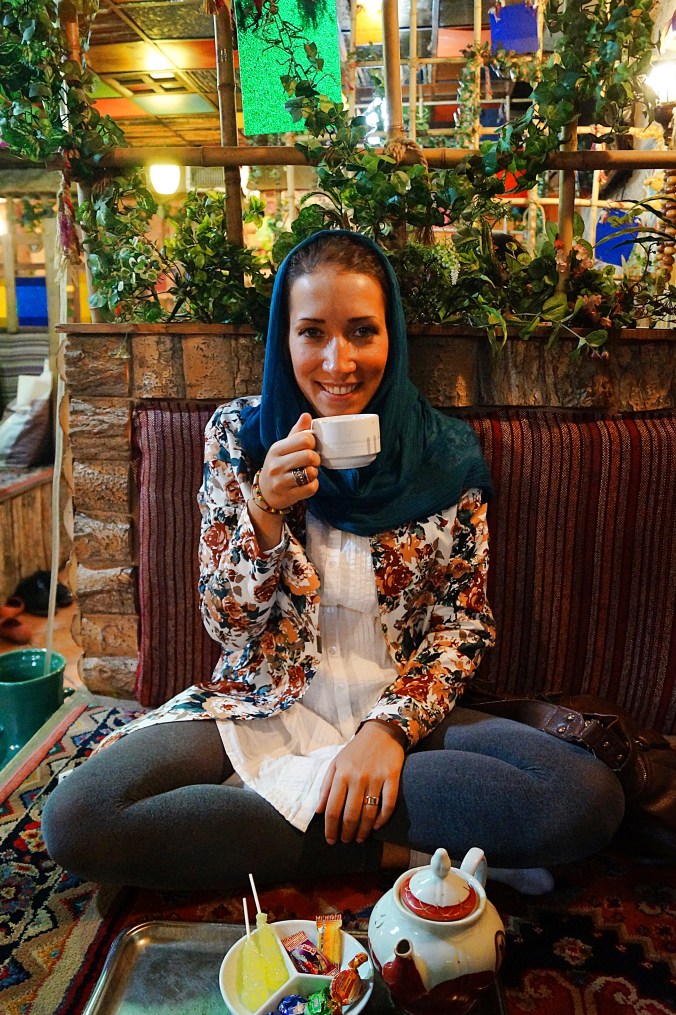
Until we finally reached our destination, the hotel I was forced to book in advance to obtain the visa: the door was shut, we knocked on it and rang the bell, nobody came into view, the taxi driver had already slipped away. I don’t know how much time we’ve been standing, perhaps half an hour, or one hour, several attempts to reach some receptionist by phone, vainly, of course; the street appeared desolate and malevolent, and some laughters, at some point, cannot but creep over, hesitant but essential.
At last, a guy showed up taking the stairs down, opened the door and welcomed us in.
To sleep turned out to be a complicated operation; however, as we awoke there was breakfast awaiting for us. No coffee, though, and I had the impression that from then on I would have hardly seen it, anywhere superseded by tea. “Mester”, giggling the waitresses named me.
Ciarlei wore the hijab and we got out into the street. Asia, we were in Asia, undoubtlessly. We felt as everyone was staring at us, the scorching temperature was unbearable, horns, bawling and asphalt perforated by jackhammers set the seal on the scene.
And there we were on the subway, into the embarrassment of trying to understand where the women should take a seat, as we searched for supportive faces who might have dispelled all doubts whether we as a couple could stay on the same wagon or not: we found out that there are two different compartments, one for females only and one mixed.
The underground of Tehran is a particular location, where boys walk back and forth selling anything and everything, socks, mp3 players, batteries, candies; we turned down their offers one by one, pleading as a perfect excuse that Ciarlei had just bought a flowery manteau in order to be overshadowed amongst the crowd, and thus we were broke.
Off to the Iran-Iraq war fallen soldiers’ cemetery, we ended up talking to an Azeri little old woman who asked us to share the taxi ride, “so that we save some money”. “You bet!” I said. The driver, Azeri too, recalled as he was a soldier, the Russian were the good for they helped them, the Yankee instead supported the others, the Iraqi.
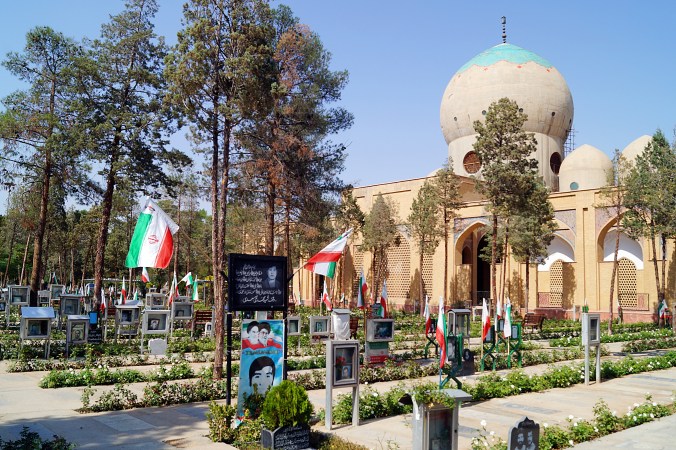
Emam Khomeini square – a total mess. Traffic lights do not count at all, to cross the road you need to follow the locals and to use them as human shields: they literally throw themselves headlong into the traffic raising arms to order the drivers to stop; after which they hope they’ll do it.
Chaos, smog, motorbikes everywhere.
We finished up in the bazar area: this is the biggest in the world.
Well, if one reads books, it seems that nowadays the Iranian women wear coloured clothes, snazzy in fact, and that the hijab, its art of veiling heads, is less and less a rigid rule; yet I noted a lot of chadors, black as tar, laid down on the overwhelming majority of women. The myriad of nose jobs, though, this exists indeed. A boundless army of small refined noses.
However, where the hell is the Golestan palace (the most famous building of the city)? We’ve been asking to around twenty people, cops included, and noone was able to help us out. We found it a couple of blocks away, eventually. Everybody looked engaged in admiring the muddle all around, into a sort of calm rapture, quite unusual to me.
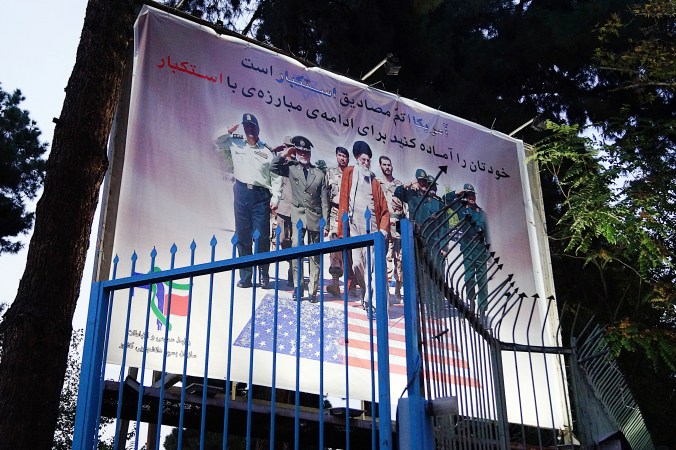
In the subway again, finally heading there, to the United States ex-embassy, which was assaulted during the 1979 revolution, the hostage crisis, Argo, two counterposed worlds. We ascended the escalator and suddenly the well-known murales unhid: the yellowish-blue writing “Down with Usa”. A step further there’s a skeletal Lady Liberty, and many other drawings spreading all too clear messages; the wall is impassable, we asked to let us in but we were laughed outright. Today the building is the headquarter of a governmental office. We took pictures fast, because it is clearly stated that it is forbidden, a little of sound fear and thrill, and not too much fast, as we were imprisoned in the desire of staying and exploring more, we packed off, just swaying.
Then we went underground once more, so that the train would take us to the hotel, the evening was about to come and a bus was awaiting for us, near Azadi square. A train passed through, then another, then another, nothing, all full to the brim, impossible to get on, we had to give up; likewise, two Iranian guys who moved close to us, sort of curious, and began to talk: one said to be a journalist, the other a religious person; they were talking at full pelt, and in the middle of a matter they came out with asking what we thought about the tragedy just happened to Mecca, where hundreds of Iranian (among others) had died trampled by a huge crowd. “It’s like our September eleventh”, the journalist said. So we decided to set out along with them, given the hopelessness to wait a train on which to get.
Outside the sky was dark, the enormous city put on its fancy dress. Words, a flood of words, amidst people, lights, walked on greengrocers and tea rooms.
Eventually we bid farewell, did exchange our telephone numbers and the two nice Iranian walked away.
As we returned to the hotel I asked to make a call to the receptionist to whom I had talked via email, who was very helpful and kind, just to make sure about the bus schedules.
“Hi, can you please tell me the bus schedule to Sanandaj?” I asked her on the phone.
“Sanandaj?! Why you are going to Kurdistan?! Nobody goes there!” she replied, sincerely surprised.
I smiled, half an hour and we were on a taxi again, in the middle of the wild fervor of motorcycles, ropey carts, cars, pedestrians, carbon monoxide deeply into our lungs and brains. And sure, full volume music from the car radio. All around smelled like Iran, but no longer the Iran seen through the movies shot by Kiarostami, Panahi and Ghobadi, not the one imagined by following the delicate lines drawn in the Persepolis cartoon nor the one visualized through the Sassanid and Achaemenids overwhelming onslaughts on interactive maps or shabby pages.
Millenniums of history. Of architecture. Of science. Of ideas.
“Why you are going to Kurdistan?!”
A magnificent adventure, or rather unspeakable, had just begun. I still, to this day, regret having lived it already, for this means it can’t happen to me anymore. Because yes, the first time is the only one that counts for something.
 Ciarlei and me.